To keep your ShapeUp in top operating condition, the following operational and tune-up tips are offered.
Operational
- The ShapeUp works best on ceramic wheels of either resinoid or vitrified bond. Other types of wheels can be shaped but tend to shorten the life of the diamond significantly.
- To maintain its sharpness, the diamond should be rotated at least at the beginning of
each shift. Heavy use might require even more frequent rotation. Replacement diamonds
should be of high quality and a minimum of 1 carat. Anything less will tend not to stand
up as well. Order PN 14130 for a replacement from Armstrong.
- After shaping with the diamond, the wheel tends to be too smooth to properly grind the saw. The saws tend to burn. It is recommended that the wheel be "opened up" by the use of a star- type wheel dresser. This exposes the grinding medium so that proper grinding can take place. We recommend the use of Desmond star dresser model BCA-4 (or equivalent) that can be ordered from your stocking distributor. This has a finer star than the "0" or "1" that is most often found in the filing room.
- The maximum amount of stock removal when shaping should be .001" (0.025 mm) which is accomplished with a very slight turn of the knob. Trying to remove more than this in one pass will quickly wear out the diamond and can cause the wheel to "suck in" the diamond creating gouges in the wheel. At the prescribed rate of removal, the diamond should pass over the wheel rather quickly – about one second across the face. If you do adjust in more than .001", a much slower rate of travel over the wheel is necessary. A new wheel should be pre-shaped with a shaping stone prior to using the ShapeUp.
Tune-up
- Periodically check to see that all attachment bolts are tight.
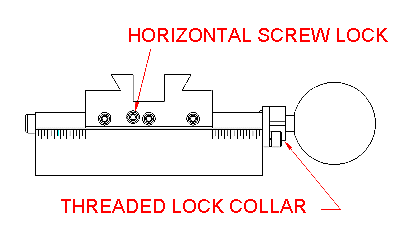
- When adjusting the diamond in or out, it should begin moving as soon as you begin to turn the knob. If you get more than 1/8 turn of screw movement before the diamond begins to move, some adjustment of the threaded lock collar shown in the drawing needs to be done. Back the knob off to remove any lash then loosen the set screw on the threaded lock collar. Screw the collar into the body of the tool. Tighten the set screw and turn knob to see if any lash still exists. Repeat as necessary. No collar adjustment is necessary on the horizontal screw as once you have this in the desired position for your wheel shape, tightening the lock screw will keep this from moving (see drawing).
- Pivot bearing assembly should be snug enough to provide drag throughout its arc. It
should not move so freely that, once unlocked, it will swing without the aid of the
operator. If it moves too freely, tighten the big bolt on top with a 5/16" Allen
wrench such that smooth drag is felt while swinging the arm through its arc. If you feel
any "hitches" in the movement, you’ve gotten it too tight.
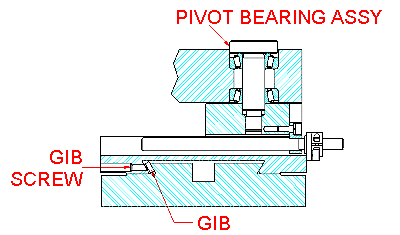
- With the pivot arm both out to the front and to the side, gently exert pressure up and down / in and out while observing and feeling for any movement in either the front-to-back or the horizontal dovetail ways (be sure horizontal lock screw is backed out). If you do detect any movement, some tightening of the gibs will be necessary. To do this, first back out all three gib screws just until they are free. Starting with the center one, gently bring them back in until they just come in contact with the gib. Again, starting with the center screw, tighten to approximately 6 in. lbs. (6.9 cm/Kg) of torque. Run the wheel adjusting and horizontal adjusting screws through their range to check for any binding or looseness again. A 3/16" Allen wrench in an electric screwdriver works well for this. Adjust torque as necessary.
- If you find that the shape of the wheel is different from a new wheel to one that is about worn out, it is possible that the whole assembly has moved out of alignment. Refer to written or video installation instructions that deal with line up of assembly to grinding wheel mounting.
Additional Notes
| Looseness in cone screws and rocker arms can cause erratic performance. Cone screws should be checked yearly and replaced as required. Heavy duty rocker arms, new rocker arm springs and longer links (#4 BSS – PN 461) will allow the ShapeUp to do the job for which it was intended more consistently. Also, aligning the arbor assembly and maintaining that alignment is essential to keeping the wheel shape the same from month to month. Alignment should always be checked after cone screws have been checked or replaced. Your Armstrong Stocking Distributor has the parts and tools necessary to maintain your Armstrong equipment. |